



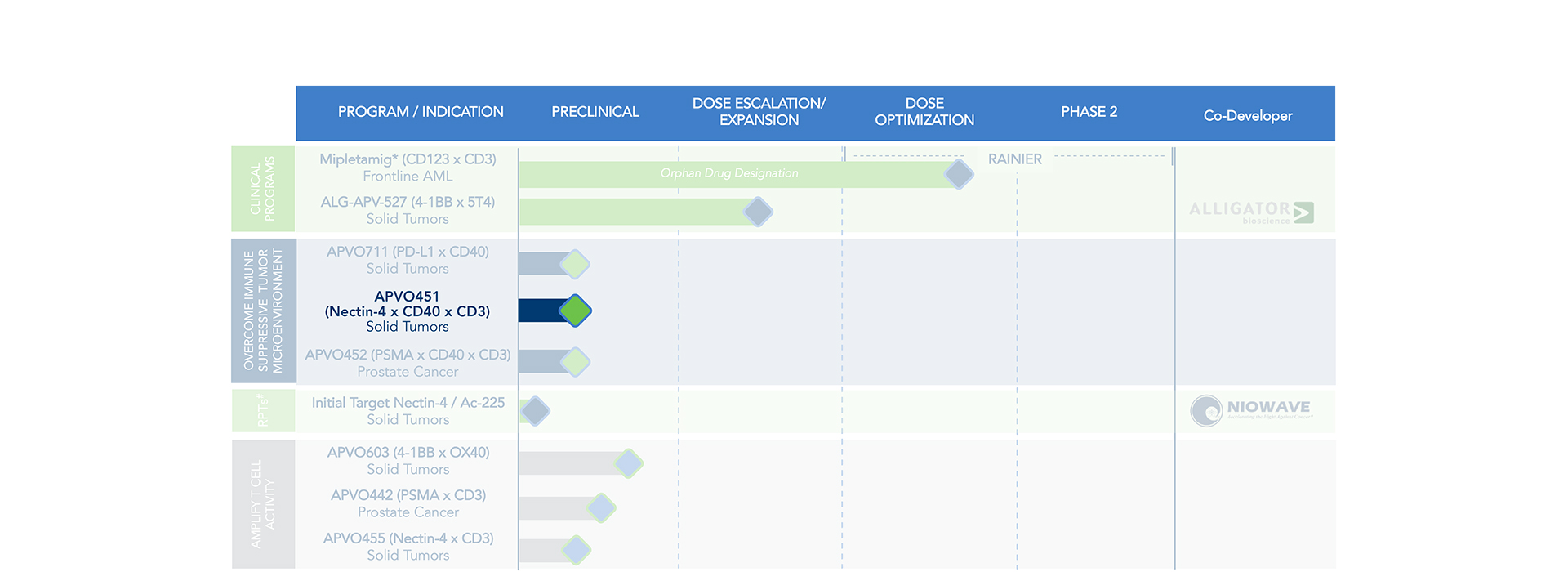
APVO451
Program supported by a grant from:

APVO451 represents the next step in Aptevo’s trispecific pipeline—an antibody engineered to address one of the central challenges in treating solid tumors: the immunosuppressive tumor microenvironment. By simultaneously activating both the innate and adaptive immune systems through CD40 and CD3, APVO451 is designed to mount a more complete immune response against cancer. Its safety-conscious design is engineered to ensure that immune activation occurs only in the presence of nectin-4-dependent crosslinking, helping to focus its effect where it is needed most.
Central to this approach is Aptevo’s proprietary application of the CRIS-7-derived CD3 binding domain, which is engineered to engage T cells while limiting the risk of systemic cytokine release. This design principle is already showing promise in the clinic: across the first five cohorts of the ongoing mipletamig (CD123 x CD3) RAINIER trial, frontline patients have demonstrated a favorable cytokine release profile—consistent with what preclinical studies predicted.
APVO451 targets nectin-4, a clinically validated marker with potential across a broad range of solid tumors, including lung, breast, colon, ovarian, and prostate cancers—indications that together represent significant unmet need and market opportunity. The program is also supported by a strong intellectual property position. Aptevo’s CD3 platform carries exclusivity through 2038 in the United States and 2037 internationally, while the trispecific technology—patent pending, filed in 2025—has projected exclusivity to approximately 2046. APVO451 is wholly owned by Aptevo Therapeutics.
Looking ahead, Aptevo expects to select a development candidate by the end of 2026 and to initiate IND-enabling studies in the first quarter of 2027.
APVO451: Designed to Address a Key Barrier in Solid Tumors by Re-Engaging Immune Activity in the Tumor Microenvironment
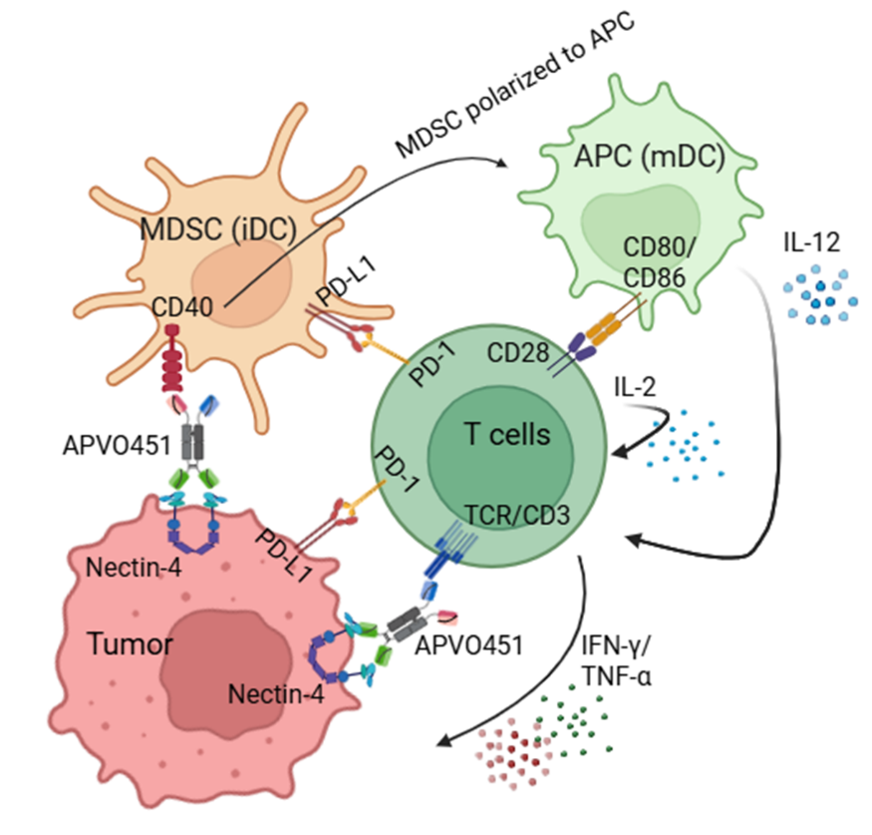
TME-mediated immunosupression
CAUSES:
-
- PD-L1 tumor expression
- MDSCs/TAMs
RESULTS:
-
- Exhausted T cells
- De-differentiated myeloid cells
- Tumor metastases
Effector T cells
-
- Stimulates activation
- Induces inflammatory cytokine production
- Promotes expansion
- Enhances T cell-mediated tumor killing
MDSCs /APCs
-
- Induces the upregulation of activation-induced co-stimulatory molecules
- Promotes polarization and cytokine production
How it works:
APVO451, a trispecific antibody engineered to recognize three distinct targets at once. Each arm of the molecule is designed to bind a specific protein: a nectin-4 single-chain variable fragment (scFv) anchors the antibody to nectin-4-expressing tumor cells, while separate CD40 and CD3 binding domains engage the innate and adaptive immune systems, respectively. By bringing these three targets together in a single molecule, APVO451 is designed to activate a coordinated immune response directed precisely at the tumor.
Trispecifics Designed to Activate a More Complete Immune Response in Solid Tumors
-
- APVO451, a novel trispecific antibody-like molecule, was designed to overcome tumor immunosuppression via dual activation of APCs and T cells through the CD40 and CD3 binding domains – engaging both innate and adaptive immunity
- The data supports the potential of APVO451 as a potent solid tumor therapeutic as it is demonstrated to ablate human NSCLC H2122 tumor cells, despite the in vitro immunosuppressive TME, and holds potential for application in multiple solid tumor types
- The intended design of APVO451 resulted in both CD3- and CD40-mediated functionality requiring nectin-4-dependent crosslinking for immune cell activation
- Within an immunosuppressive TME, APVO451 drives cytokine production and enhances APC and T cell activation and cytotoxicity more effectively than bispecific control molecules