



ALG.APV-527
ALG.APV-527
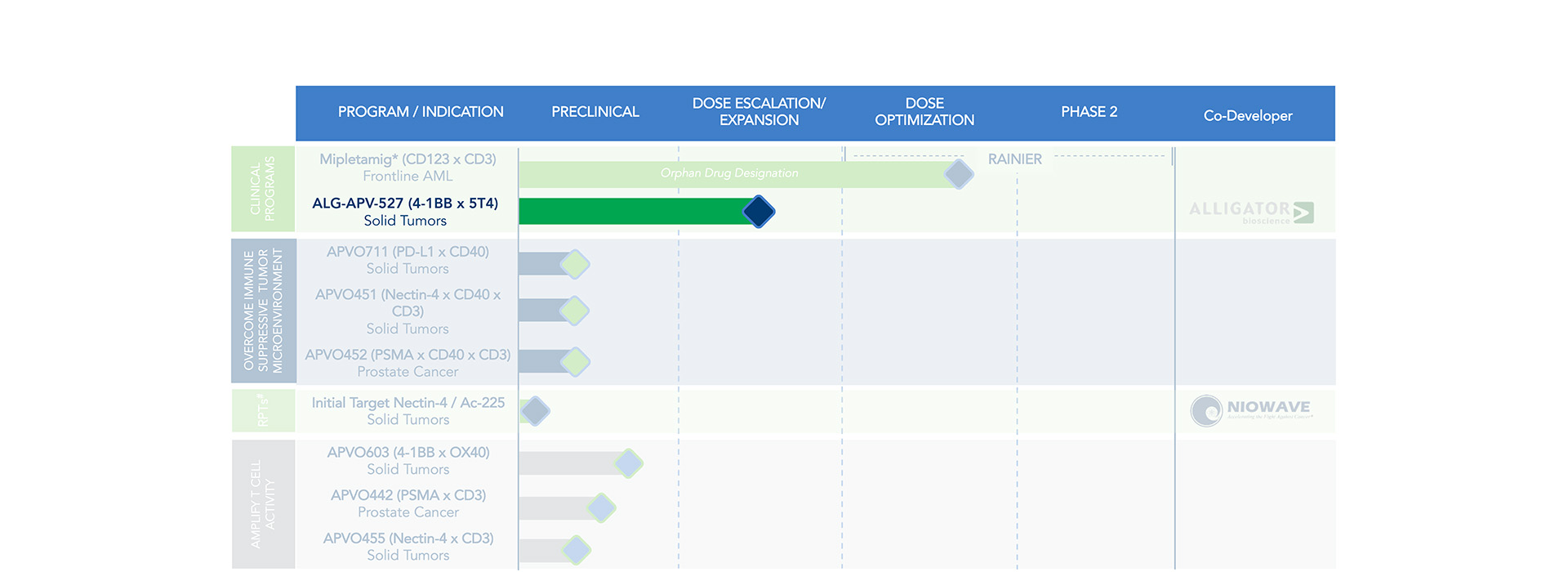
Bispecific antibody targeting solid tumors through 5T4 and controlled immune activation through 4-1BB. Built on Aptevo’s ADAPTIRTM platform, it is designed to improve safety and efficacy across multiple solid tumor types.
ALG.APV-527 is a bispecific antibody designed to bring precision and safety to immune activation in the treatment of solid tumors. It works by simultaneously targeting 4-1BB—a costimulatory receptor found on CD8⁺ T cells and natural killer cells—and 5T4, an antigen commonly expressed on tumor cells. This dual-targeting approach drives immune activation conditionally, focusing its effect within the tumor microenvironment. Importantly, ALG.APV-527 is engineered to overcome the safety challenges seen with earlier first-generation 4-1BB agonists by requiring 5T4-dependent activation, helping to concentrate the immune response where it is needed while limiting off-target effects.
Early clinical results have been encouraging. In a heavily pretreated patient population, 59% of evaluable patients achieved a best overall response of stable disease, and biomarker analyses have confirmed the antibody’s biological activity. Treatment was also well tolerated, reinforcing the promise of its safety-conscious design.
Because 5T4 is expressed across a wide range of solid tumors, ALG.APV-527 has potential application in multiple cancer types, including lung, breast, head and neck, colorectal, and pancreatic cancers—indications that together represent significant unmet need and market opportunity. The program is advanced through a 50/50 joint ownership and co-development agreement with Alligator Bioscience, and is supported by patent exclusivity through 2038, with the potential for up to five additional years of patent term extension.
The design of ALG.APV-527 begins with a simple but important question: how can the immune system be activated against a tumor without triggering the widespread toxicity that has limited earlier therapies? The answer lies in the careful selection of two complementary targets—4-1BB and 5T4—that work together to focus immune activity precisely where it is needed.
Why We Are Targeting 4-1BB + 5T4
-
4-1BB signaling enhances T cell and NK cell effector functions, promoting tumor cell killing
-
4-1BB is a costimulatory receptor expressed on tumor infiltrating T cells and NK cells but NOT on peripheral blood cells, allows for precision targeting of tumor cells
-
5T4 is an antigen expressed on tumor cells but NOT highly expressed on normal tissue, further allowing for precision targeting and reducing systemic toxicity
-
527 only induce 4-1BB signaling when crosslinked with 5T4-expressing tumor cells, minimizing systemic toxicity seen with previous 4-1BB agonists
-
Both 4-1BB and 5T4 are pre-clinically and clinically validated targets
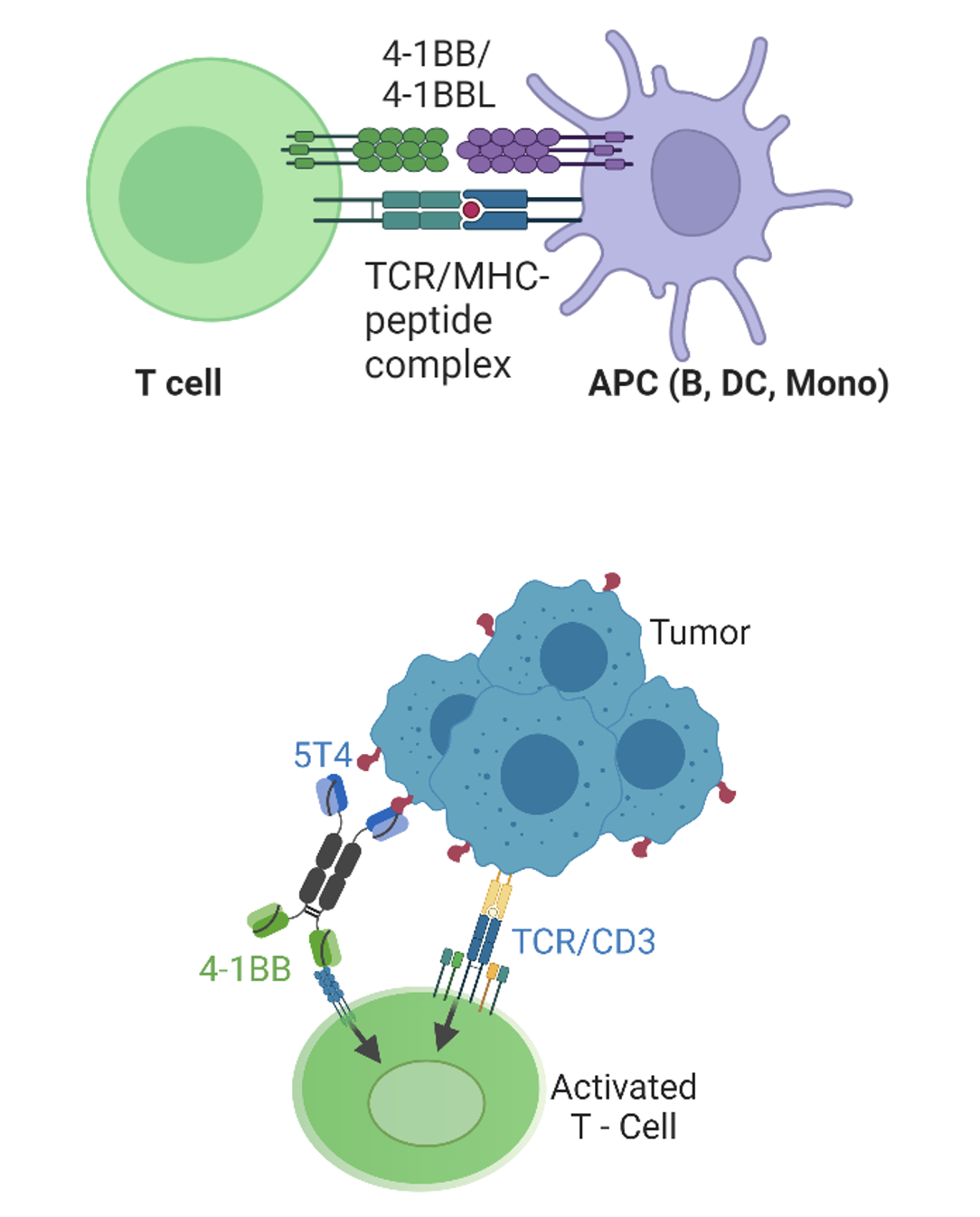
Together, 4-1BB and 5T4 provide a powerful basis for precision immune activation. Because 4-1BB is found on tumor-infiltrating T and NK cells rather than circulating blood cells, and 5T4 is expressed on tumor cells but largely absent from healthy tissue, ALG.APV-527 can concentrate its effect within the tumor while minimizing systemic toxicity—engaging 4-1BB signaling only when the antibody is crosslinked to a 5T4-expressing tumor cell. With both targets validated in preclinical and clinical settings, this dual-targeting strategy offers a rational, well-supported path toward safer and more effective treatment of solid tumors.
ALG.APV-527 Clinical Data: Favorable Safety, Pharmacology
Safety & Tolerability: treatment was well-tolerated
- No severe liver toxicity observed, a side effect associated with dose-limiting toxicity of previous 4-1BB agonists
- No CRS observed
- Most common adverse events were fatigue (22%), infusion-related reaction (22%), diarrhea (17%) and pruritus (17%)
Very Favorable Pharmacology: exposure measurable in all patients, aligned with preclinical predictions
- Drug levels were measurable in every patient. Exposure increased with dose, as expected
- Favorable terminal half-life of nine days
- Serum biomarkers demonstrated target engagement and ALG.APV-527-induced immune activation
- In tumors from treated patients both targets were present, and T cells were increased as evidence of mechanism of mechanism
ALG.APV-527 Clinical Data: 59% Achieved Stable Disease as a Single Agent
Promising data from the ALG.APV-527 multi-center Phase 1 dose escalation trial is as follows:
Patients on study had been heavily pretreated and refractory to standard of care*.
10 of 17 efficacy evaluable patients (59%) achieved stable disease (SD) in monotherapy, some patients experienced prolonged SD
- The longest SD duration was in a breast cancer patient who entered the study with progressive disease, achieved SD and remained on study for >11 months. This patient successfully transitioned to a higher dose level twice
- One colon cancer patient remained on study and in SD for six months
- One prostate cancer patient remained on study and in SD for more than four months
Dose range evaluated: 0.1 mg/kg – 12 mg/kg